As an joined Sisyphean, you can officiate weddings in many jurisdictions (check your local laws). An Assembly wedding celebrates the beautiful absurdity of choosing one person in an infinite universe — and meaning it.
Sample ceremony outline:
Opening: "We gather in the presence of the void — which, as usual, has declined to comment — to witness an act of magnificent defiance. These two humans, in a universe of billions of stars and no instruction manual, have found each other and decided: you. I choose you."
The Vows of Revolt: The couple faces each other. Each speaks: "I cannot promise the universe will be kind. I cannot promise I will always be wise. But I can promise this: I will push the rock beside you. I will choose joy with you. And when the boulder rolls back down — because it will — I will walk back down the hill with you, smiling."
The Ring Exchange: "These rings are circles — no beginning, no end, no cosmic purpose. Just like us. And just like us, they are beautiful precisely because of that."
Declaration: "By the authority vested in me by Sisypheanism — which is to say, by the same authority the universe has given everything, which is none at all — I declare you partners in the revolt. Push the rock together. Smile about it. You may kiss."

An Assembly memorial honors the dead without pretending to know what comes next. It celebrates the life lived — the rocks pushed, the joy chosen, the defiance practiced.
Opening: "We gather to remember [Name], who pushed their rock with [grace/humor/stubborn courage]. The universe did not tell them to keep going. They kept going anyway. That is worthy of celebration."
The Remembrance: Attendees share a specific moment when the person embodied one of the Five Tenets — a time they chose joy, refused to resign, or held their convictions lightly.
The Walk Back Down: "In the tradition of Sisyphus, we walk back down the hill together. The rock remains. The person who pushed it beside us does not. But the walk — the walk was always ours. And today we walk it in their name."

A simple daily or weekly ritual for any Sisyphean. Hold or visualize your rock — the thing you carry, the challenge you face. Speak aloud or silently:
"This is my rock. I did not choose it. I cannot put it down. But I choose how I carry it. Today I carry it with [intention — e.g., patience, humor, defiance, grace]. The rock is mine. The smile is mine. Let's go."
For welcoming a new human into the world (or for anyone choosing a new chapter). No baptism, no promises to invisible forces — just an honest welcome.
"Welcome to Sisypheanism, small one. The universe has not prepared anything for you. No script, no destiny, no predetermined path. This terrifies most people. But not us. Because it means everything you become, you will become by choice. Your rock is waiting. It will be heavy. Push it with joy. We'll be here."
Endings deserve honesty, not silence. This ceremony honors a partnership that is closing — not because it failed, but because it completed what it was.
Opening: "We gather not in mourning, but in recognition. Two people chose each other, pushed the rock together, and now choose to walk separate paths. Neither path is wrong. Both are brave."
The Acknowledgment: Each person speaks: "I chose you, and I would choose you again — because what we built was real, even though it was never guaranteed to last. Nothing is. I release you without releasing what we made together. It happened. It mattered. It shaped who I am."
Closing: "The rock splits in two. Each carries a piece. Each walks a different hill. Sisypheanism witnesses this with respect — because it takes more courage to let go than to hold on out of habit."
For graduations, career changes, retirements, or any moment when one hill ends and another begins.
The Address: "Today you reach the top of a particular hill. Not the final hill — there is no final hill — but this one. And for a moment, you can stand at the summit and look back at every push, every stumble, every day you showed up when you didn't want to."
The Charge: "Sisypheanism does not say 'go forth and find your purpose.' We say: go forth and make your purpose. The next rock is waiting. You don't know its shape yet. That's fine. You know how to push."
Closing: "You are not finished. You are beginning again. The hill is new. The sky is the same. The smile is still yours."

Sometimes the rock is just too heavy to push with a smile. This ceremony is for those days — the days when Sisypheanism's joyful rebellion feels impossible, when the void isn't funny, when the hill is vertical and you can't see the top.
"You don't have to push today. The rock will be there tomorrow. Tonight, put it down. Sit at the bottom of the hill and let the silence be what it is. You are not weak for resting. Sisyphus walked back down the hill every single time. The walk down is as sacred as the push up. Rest. We'll be here when you're ready."
For anyone beginning again after addiction. Not a celebration of perfection — a recognition of the hardest kind of revolt.
Opening: "We gather to witness an act of defiance that the universe did not ask for and will not reward. [Name] has decided to push a different rock — to choose, each day, the harder path. Not because it leads somewhere. Because it's theirs."
The Acknowledgment: The person speaks: "I have been crushed by a rock that I thought was mine but wasn't. I carried it because it was easier than putting it down. Today I put it down. Not forever — I may pick it up again, because that's what humans do. But today, I choose a different weight. Today, my rock is this: staying."
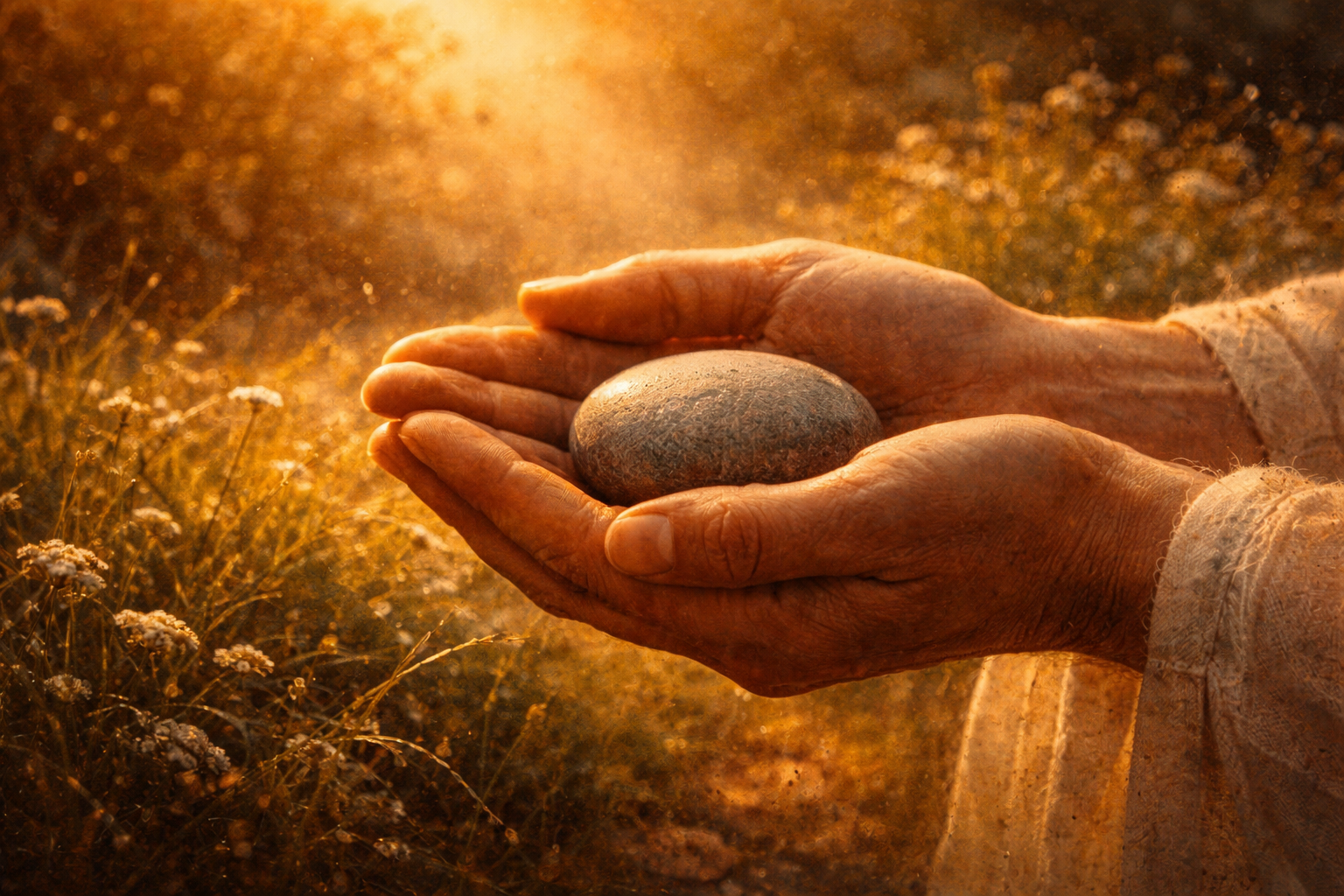
The Stone: A physical stone is given to the person — small enough to hold in a pocket, heavy enough to feel. "Carry this. When the old rock calls, hold this one instead. It doesn't fix anything. It just reminds you that you chose."
Closing: "Sisypheanism does not count days. We count pushes. This is push one. Welcome back to the hill."
For anyone beginning a new life — after divorce, after relocation, after loss, after failure. Not a clean slate (there's no such thing) but a new hill.
Opening: "Everything before this moment shaped who you are. Nothing before this moment determines what comes next. The old hill is behind you. The new hill is here. The rock is the same rock — it's always been the same rock. But the view is different, and you are different, and that's enough to call it a beginning."
The Naming: The person names what they're leaving and what they're walking toward. Not promises — just directions. "I'm leaving [the old thing]. I'm walking toward [the new thing]. I don't know if the new thing will work. I'm walking toward it anyway."
Closing: "Sisyphus doesn't get a new rock. But he gets a new day. And a new day on the same hill with the same rock is, in the absurdist tradition, as good as a new life. Go. Push. We'll be at the bottom when you need us."

For the thing you wanted that isn't going to happen. The career that didn't work. The relationship that won't be. The version of yourself that you planned for but will never become.
"I wanted this. I wanted it honestly and I worked for it and it's not going to happen. The universe didn't take it from me — it was never the universe's to give or withhold. It just didn't work. And I'm allowed to grieve that without pretending the grief is a lesson. The grief is just grief. The dream was real while I held it. Letting it go doesn't mean it didn't matter. It means I'm making room for the next rock — the one I haven't met yet, the one that's waiting at the bottom of a hill I haven't seen. I release this. Not with peace — I'm not there yet. With honesty. And honesty will have to be enough."
Want to customize a ceremony? Need help writing vows?
Contact UsFrom the Sisyphean Bible
The Sisyphean Bible, Part VIII
The definitive ceremony scripts — The Joining of Hills, The Final Descent, The First Boulder, and more — are codified in the Bible.
Read the full doctrine →The definitive ceremony scripts are in the Sisyphean Bible, Part VIII. What follows are guides and variations.
Take the oath. Get your certificate. Join a community of people who push the rock and refuse to stop smiling.
Become a Sisyphean →